

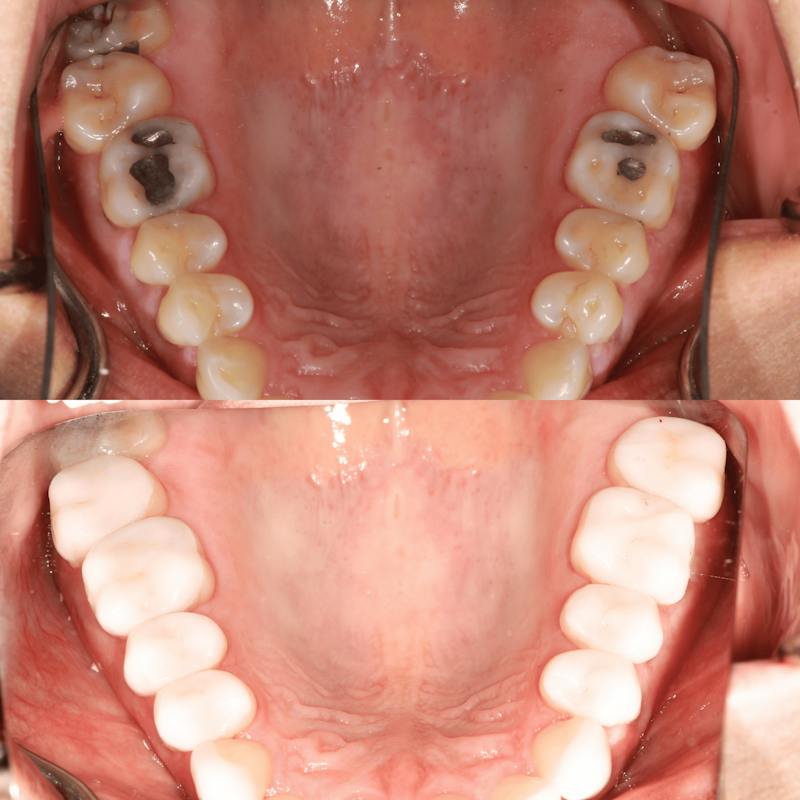
You can often repair a damaged tooth by removing only the decayed or broken part and rebuilding it with bonded materials, but the right choice depends on the damage. Early decay may be managed without drilling; small chips may need only a filling, and larger breaks may call for an onlay. Deep cracks or major structural loss can still require a crown or root canal, and only an exam can tell which applies to you.
This article walks through the options from least to most invasive, so you can have an informed talk with your dentist. It is educational and is not a diagnosis.
What does it mean to preserve healthy tooth structure?
Preserving healthy tooth structure means removing only the tissue that is decayed or broken, then rebuilding the tooth with materials that bond to what remains. Dentists measure success by how much natural tooth is kept, not only by how well the repair looks. Each extra bit of tooth removed cannot grow back.
The problem is common. Nearly 21% of US adults aged 20–64 had at least one permanent tooth with untreated decay, according to the CDC's 2024 Oral Health Surveillance Report.
An international expert group, the International Caries Consensus Collaboration, advises dentists to avoid entering the "restorative cycle" (repeated drilling and replacing of fillings) as far as possible. When a restoration is needed, its priorities are to keep healthy and remineralizable tissue, create a good seal, protect the nerve (pulp), and make the repair last (Schwendicke et al., 2016).
The group also describes selective removal. In shallow or moderately deep cavities, the dentist removes decay until the remaining dentine (the layer under enamel) feels firm. In deep cavities, some softened dentine near the nerve may be left and sealed under the restoration.
Can early tooth damage be treated without drilling?
Sometimes, very early decay that has not formed a hole may be stopped or reversed with nonrestorative care, such as sealants, fluoride products, or silver diamine fluoride, a liquid that helps arrest decay. Once a cavity can no longer be cleaned or sealed, a restoration is usually needed.
An expert panel convened by the American Dental Association made 11 recommendations on nonrestorative treatments, each specific to lesion type, tooth surface, and tooth type (Slayton et al., JADA 2018). Silver diamine fluoride can darken treated areas, so dentists should explain that tradeoff first.
This kind of care works best when decay is found early, which is one reason regular exams matter.
When is a bonded filling enough?
A bonded filling is often enough when a tooth has a chip or a smaller area of damage, and a strong enough tooth remains to support it. Bonded means the tooth-colored material sticks to the tooth, so the dentist does not need to cut extra shape into the healthy tooth to hold it in place.
A fractured cusp is one example. This is when a piece of the chewing surface breaks off, often around an existing filling. The American Association of Endodontists (AAE) says a fractured cusp rarely damages the nerve, and a dentist can place a new filling or a crown to protect the tooth (AAE).
If too little strong tooth remains, a filling may not hold up. In that case, your dentist may suggest a partial-coverage restoration such as an onlay, covered next.
Onlay or crown: how much tooth does each remove?
A crown removes more healthy tooth than most partial repairs. In one lab study, full crown preparations removed 63% to 72% of a model front tooth's crown by weight. An onlay is a partial-coverage restoration that covers only part of the tooth, so it aims to leave more of the natural structure.
| Preparation type (model front teeth, lab study) | Tooth structure removed, by weight |
|---|---|
| All-ceramic or metal-ceramic crown | 63%–72% |
| Ceramic veneer or resin-bonded preparation | 3%–30% |
Source: Edelhoff & Sorensen, J Prosthet Dent 2002. This was an in vitro study on resin model teeth, so real-world results vary by tooth and case.
Note that this study measured front-tooth designs. Your dentist can explain how a similar comparison applies to a back tooth. For very thin front-tooth repairs, see these ultra-thin veneers.
How do onlays hold up? A 2022 meta-analysis found that tooth-colored onlays and partial crowns performed as well as full crowns on back teeth in the short term. It was based on one randomized trial and five observational studies, and the authors called for long-term trials (Wang et al., 2022). A 2025 review of randomized trials reported a 3-year survival rate of 93.7% (95% CI 83.7–97.7) for lithium disilicate partial-coverage restorations (Prott et al., 2025). Long-term data are still limited.
To learn how one practice approaches this choice, see its page on onlays instead of crowns.
What about cracked teeth and deep decay near the nerve?
Cracked teeth and deep decay need individual evaluation, because the right repair depends on how far the damage reaches. Shallow enamel lines often need no treatment, while deeper cracks may need a crown. For deep decay, consensus guidance favors protecting the nerve by leaving some softened tissue sealed beneath the restoration.
Cracks. The AAE says craze lines are tiny cracks in the outer enamel that are common in adults, cause no pain, and matter only for appearance. A truly cracked tooth is different. Its crack runs from the chewing surface toward the root and will not heal like a broken bone. A crown gives maximum protection but does not guarantee success, and most cracked teeth treated early keep working for years (AAE). The AAE advises seeing a dentist promptly, since earlier treatment leads to better outcomes.
Can a tooth be saved without a root canal? Sometimes. In deep decay, the consensus guidance puts nerve health first. Leaving some softened tissue sealed near the nerve is meant to lower the risk of exposing it, which may help a tooth avoid a root canal. Not every tooth qualifies, and a damaged nerve may still call for root canal treatment.
If damage affects many teeth, a broader plan, such as full mouth reconstruction, may be discussed.
What is biomimetic dentistry, and what does the evidence show?
Biomimetic dentistry is an approach that tries to restore a tooth so it behaves like a natural one, by saving as much of the tooth as possible and bonding materials to it. Its tissue-saving principles are broadly accepted, but researchers say claims for specific protocols still need stronger clinical trials.
In practice, the approach leans on selective decay removal, adhesive bonding, and partial-coverage restorations where appropriate. A narrative review in the Journal of Applied Oral Science concluded that more rigorous research is needed on outcomes that affect longevity, such as fracture, debonding, and post-operative sensitivity (Reis et al.).
That does not make the idea wrong. It means you should ask any dentist what evidence supports the method they recommend. To see how one practice describes its approach, read about its biomimetic restorations.
How do I choose the right repair? Questions to ask your dentist
The best repair is the one that fixes the problem while keeping the healthiest tooth, and your dentist can only judge that after an exam and X-rays. Ask which options exist, how much tooth each removes, and what could go wrong, so you can compare choices before agreeing to a crown or root canal.
Questions worth asking:
- What is wrong with this tooth, and how deep does the damage go?
- Is my nerve healthy, and does that change the options?
- Could a bonded filling, onlay, or nonrestorative care work here? If not, why?
- How much tooth will each option remove?
- What evidence supports this choice, and what are its limits?
- What happens if the repair fails?
A second opinion is reasonable for any major treatment, and a good dentist will welcome your questions.
Conclusion
You can often repair a damaged tooth while keeping as much of it as possible, but the right method depends on the size of the damage, how deep a crack runs, and the health of the nerve. Compare options by how much tooth each removes, ask about evidence, and get an exam. To discuss your tooth with a biomimetic dentist in Los Angeles, visit Dr. Paul O'Malley's website.
Frequently Asked Questions
Can a chipped tooth be repaired without a crown?
Often yes, when enough healthy tooth remains to support the repair. A small chip can sometimes be rebuilt with a bonded filling, while a larger break of the chewing surface may call for a new filling or a crown. A dentist must examine the tooth because the choice depends on how much structure is left.
Does a craze line need treatment?
Usually not. Craze lines are tiny cracks that affect only the outer enamel, are very common in adult teeth, and cause no pain. The American Association of Endodontists says they matter only for looks. See a dentist if a tooth hurts when you bite or reacts sharply to hot or cold, since that can signal a deeper crack.
How long do onlays last?
Long-term data are limited. In a 2025 review of randomized trials, lithium disilicate partial-coverage restorations had a 3-year survival rate of 93.7%. An earlier meta-analysis found onlays performed comparably to full crowns in the short term, but called for longer trials. Your results depend on the tooth and bite.
Is "no-drill" dentistry real?
For some early decay, yes. An expert panel convened by the American Dental Association made 11 recommendations on nonrestorative treatments, such as sealants, fluoride, and silver diamine fluoride, to arrest or reverse lesions. Which option fits depends on lesion type, tooth surface, and whether it is cavitated. Teeth with structural damage usually still need a restoration.
When is a crown the better choice?
A crown may be better when a crack runs deep or a tooth has lost a large amount of structure. The American Association of Endodontists notes that a crown gives a cracked tooth maximum protection, though it does not guarantee success in every case. Your dentist weighs crack depth, nerve health, and how much tooth remains.